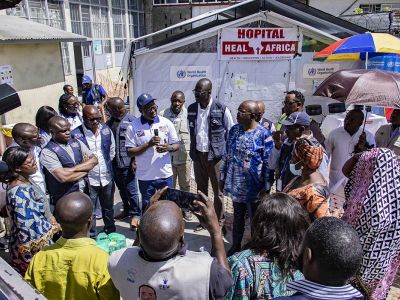
More Than a Health Crisis: How Conflict Compounds HEAL Africa’s Ebola Response
25 August 2026
Responding to Ebola is difficult in any setting. In Goma, eastern DR Congo, HEAL Africa is doing so amid conflict, restricted movement, disrupted banking, supply shortages and widespread trauma. Drawing on his first-hand experience, Pytchen Kalonda explains why lasting peace is so urgently needed.
This article is based on WorldShare’s July 2026 conversation with Pytchen Kalonda, Project Coordinator at HEAL Africa in Goma, for the On Mission with WorldShare podcast.
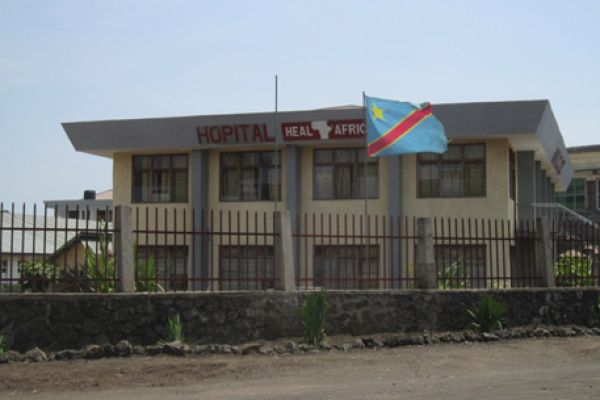
When an outbreak of Ebola reaches a community, an effective response depends on trained medical staff, suitable facilities and reliable access to medicines and protective equipment.
For HEAL Africa Hospital in Goma, providing that response has been made considerably harder by the conflict affecting eastern DR Congo.
When WorldShare spoke to Pytchen Kalonda in July 2026, he described a city where the international airport and commercial banks had been closed for around eighteen months. Movement across the nearby border with Rwanda was restricted, while different parts of the wider region were under opposing control.
These challenges affect far more than the movement of people and money. They make it harder for healthcare providers to obtain essential supplies, cooperate across affected areas and respond to the growing needs of vulnerable communities.
For HEAL Africa, the Ebola outbreak is not simply a health emergency. It is one more crisis in a region already facing conflict, displacement, poverty and trauma.
In many countries, hospitals can order medicines and equipment through established supply routes. Staff can travel, money can be accessed through banks and urgent items can be transported by air.
In Goma, these systems have been severely disrupted.
“Our international airport is still closed for now a year and a half,” Pytchen explained. “The commercial banks and all the banks in Goma are closed up to now.”
Even people who had money in their bank accounts could not necessarily access it locally. Pytchen said that reaching a functioning branch could mean travelling approximately 350 kilometres to another city, at a cost of at least $100.
For families already living in extreme poverty, this presented an enormous obstacle. For an organisation responding to urgent medical and community needs, it created another layer of practical and financial difficulty.
The Ebola outbreak also brought further restrictions. At the time of the conversation, Pytchen explained that people could not cross the nearby border with Rwanda, although medicines and equipment were still permitted to pass.
When healthcare systems are already operating under pressure, every disruption matters. A closed road, inaccessible bank or restricted border can delay supplies and make an emergency response more difficult and expensive.
HEAL Africa’s response requires medicines, protective equipment, sanitiser and other essential supplies. Establishing and staffing an isolation ward also places additional demands upon the hospital.
Team members assigned to the ward must focus on caring for suspected and confirmed patients. This requires dedicated staff to be available around the clock, rather than working elsewhere in the hospital.
Yet obtaining the necessary resources is far from straightforward. Pytchen explained that HEAL Africa relies heavily on the relationships it has developed with suppliers and other contacts beyond Goma.
“We praise God because of the good relationships we have with people,” he said. “We try to negotiate with some of the providers out of Goma, somewhere in Uganda and Kigali. They can provide equipment and medicines up to our border, and we can get them from the border to DRC.”
These arrangements allow essential items to reach HEAL Africa when usual routes are unavailable. However, they also show how much additional coordination is needed simply to obtain the supplies required to keep patients and medical staff safe.
Support provided through WorldShare has helped HEAL Africa obtain medicines, protective supplies and hand sanitiser. In a situation where local resources are severely limited, this practical assistance has strengthened the hospital’s response and helped its team continue caring for vulnerable people.
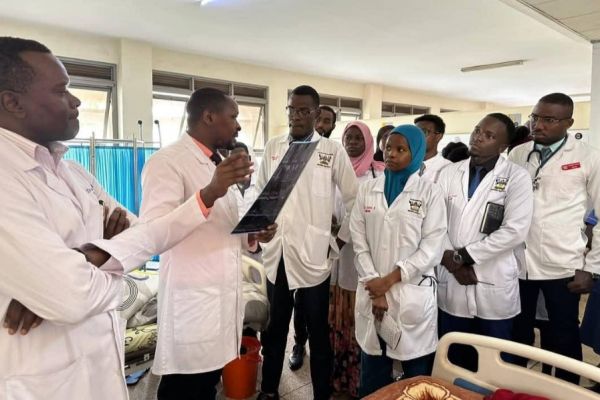
Conflict has also divided communities and healthcare services across the region.
During the interview, Pytchen explained that Goma and some of the other cities affected by Ebola were under the control of opposing sides. Although HEAL Africa had experience and expertise to contribute, these territorial divisions meant its teams could not participate directly in treating patients in certain other areas like Ituri province, the epicentre of the current outbreak.
This illustrates a wider consequence of conflict. Disease does not recognise territorial boundaries, but the people and organisations responding to it may be unable to move freely or work together.
Information, equipment and medical expertise can become separated by lines of control. Those divisions add further complexity to an outbreak that already requires cooperation, communication and rapid action.
Through its rigourous protocols and community engagement programmes, HEAL Africa has successfully prevented the spread of Ebola in Goma, for now. However, the wider situation limits how far its direct response can reach.
The practical effects of conflict are serious, but the human cost extends much further.
Repeated fighting has forced people to leave their homes and seek safety elsewhere. Pytchen explained that when conflict reaches a community, families often take refuge in churches, schools and other public places.
Many arrive carrying the effects of profound loss and disruption. They may have left behind their homes, possessions, livelihoods and support networks. Some are also facing illness, poverty or concern for relatives from whom they have become separated.
“The situation of war and all that we are crossing has created a trauma, a general trauma situation in the community,” Pytchen said.
HEAL Africa seeks to provide holistic healing in response to these interconnected needs. Alongside its medical professionals, the organisation has psychologists and community teams with different areas of expertise.
Church leaders, pastors and chaplains also have an important part to play. They are often among the people welcoming displaced families and accompanying them through uncertainty. HEAL Africa therefore wants to equip them not only with reliable health information, but also with the skills needed to support people living with displacement and trauma.
Conflict, poverty, disease and emotional distress cannot always be separated neatly. A person entering a church or hospital may be affected by several of them at once.
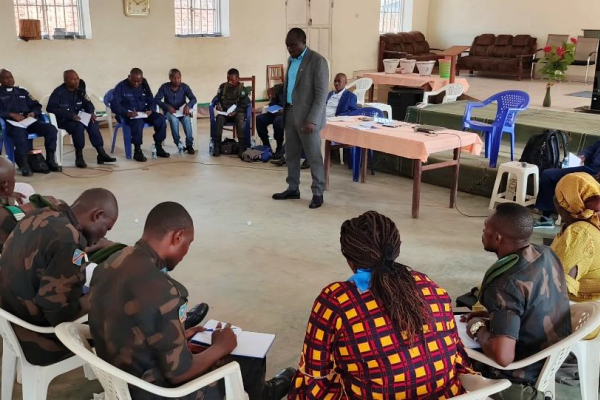
HEAL Africa has considerable experience, dedicated staff and strong relationships within the communities it serves. Nevertheless, the scale of need can be overwhelming.
“People are expecting something from HEAL Africa, but HEAL Africa does not have enough resources to respond,” Pytchen explained. “We can see the vulnerable coming to us, but we are limited in resources.”
That is a painful reality for an organisation committed to serving people who have few other places to turn.
HEAL Africa’s teams continue to draw on their experience and resilience, responding medically through the hospital and practically through community projects and training. Local churches provide places of welcome, trusted communication and spiritual support.
WorldShare stands alongside HEAL Africa, helping to provide resources that allow its locally led work to continue. That partnership is especially important when conflict has weakened the systems and supply routes on which an effective health response would ordinarily depend.
When Andrew Yelland asked how WorldShare supporters could pray, Pytchen’s first request was for peace in DR Congo.
Peace would mean far more than an end to fighting. Pytchen explained that it could allow Goma’s airport and banks to reopen, improve the economic situation and begin restoring ordinary community life.
“People are really living in extreme poverty conditions,” he said. “The population is suffering.”
Until that peace comes, HEAL Africa will continue serving amid extraordinary challenges, offering skilled medical care, practical support and the hope found in the Gospel.
Hear more from Pytchen Kalonda as he speaks with Andrew Yelland about HEAL Africa’s response, the challenges facing communities in eastern DR Congo and how we can pray.